Sustainable Tourism in Thailand

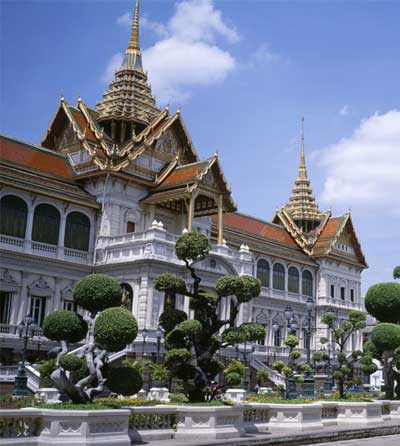
Thailand has been fortunate to benefit from exponential tourist growth. Visitors entering the country have doubled each successive decade since the 70s and now numbers more than 15 million people every year. This is a huge benefit to the Thai economy, bringing in more than $15 billion a year.

Tourism on the Andaman Coast

It is no surprise that tourism on the Andaman coast has been on the rise in recent years. Phuket still remains the runaway leader in the region. However, increasing numbers of visitors are looking further afield for a more enjoyable holiday experience in a less developed area.

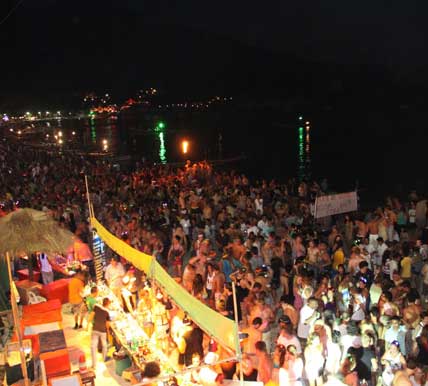
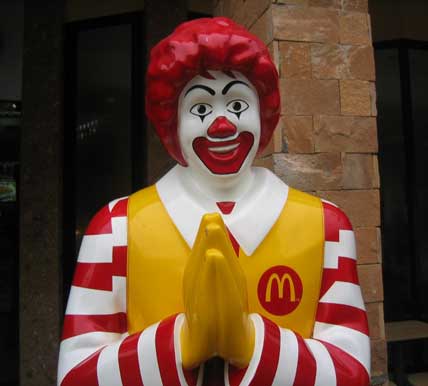
These are people who love Thailand, who feel that places like Phuket and Koh Samui have gone too far. Brimming over with 7-11s, McDonalds and Starbucks these destinations lose the underlying culture that once made them so charming. Often the arrival of these chains marks the beginning of the end of the area as many of the distinctive Thai cultural traits get lost in a sea of homogeneity.

thailand tourism
Promotion of tourism in Thailand has led to the industry to explode. More than 15 million people visit every year.
cultural thourism thailand
One of the original reasons to visit a country like Thailand was to delight in the cultural differences
cultural homogenity
Now multinationals exploit native societies through a bizarre fusion of values to sell more product
Sustainable tourism - an oxymoron?

It does not take a huge stretch of the imagination to wonder whether tourism is ever sustainable. Is the tourist footprint ever a good one?

As visitors look beyond Phuket into Phang Nga we see signs that Thailand must be careful of the long term impact of mass tourism. The temptation to cash in on the tourist boom is all too evident as legions of multinational resorts push through Khao Lak towards our beloved Koh Phra Thong.

So many areas have been irreparably damaged in this way. The bulldozers and pollution slowly destroy the natural habitats. Obviously, the scenery is a prime reason why the tourists come. So with the nature on the wane, the motivation to come is removed and the next wave of tourists never arrive. This remains the irony of eco-tourism.

Hope for Koh Phra Thong?

The encroachment of mass tourism has yet to reach our shores, but it is not far away. Koh Kho Khao to the south is becoming increasingly popular whilst Koh Phayam to the north is widely recognised as a trendy travellers hotspot. Koh Phra Thong is next on the radar.

Thankfully, we have a community of operators on Koh Phra Thong with an understanding of the pressures of mass tourism. Between us we hope to have the integrity and influence to guide the island to develop in a more sustainable way.
Golden Buddha Beach Resort
view of koh ra - thailand from longtail boat
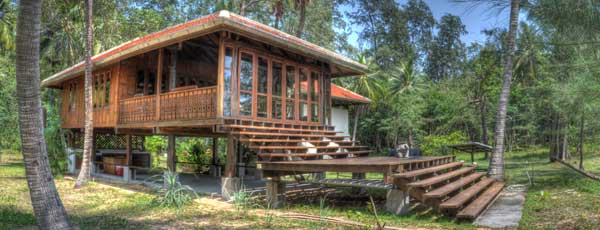
Houses at Golden Buddha Resort are built by local craftsmen from sustainable hardwood sources. They are very generously spaced and do not spoil the natural landscape

- houses all built out of plantation hardwood by local Thai craftsmen
- strict building height restrictions and only 12.5% per one rai plot
- all Thai staff - 90% local to the island -paid a decent wage and holiday pay (very unusual in Thailand)
- ongoing training for staff
- electricity from 6pm - 11pm
- no hot water (you dont need it), no air-con (the sea breeze is fine), no swimming pool (there is a bay with warm clear water next to the resort)
- recycle own and others waste, taking it back to the main land

Naucrates - Conservation Biology
view of koh ra - thailand from longtail boat
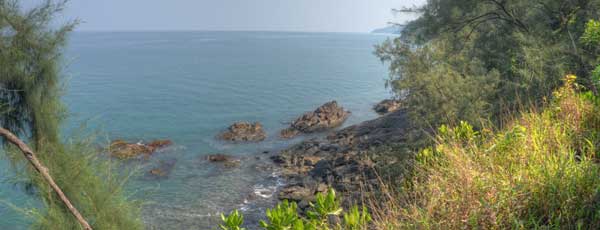
View north from the top of Hornbill Hill at the end of Golden Buddha Beach. Every day Naucrates volunteers watch for turtles breaking the surface to breath

- running community and nature tourism projects on Koh Phra Thong since 1996
- sea turtle monitoring the extensive beaches of Koh Phra Thong between January and April to find and protect nesting sites
- mangrove rehabilitation project to restore depleted areas
- sponsored teacher in Baan Lions school providing education in english and the environment
- Naucrates volunteers based in Baan Lions providing much needed income for the village
- development of homestay program in Baan Lions

Blue Guru Diving
view of koh ra - thailand from longtail boat
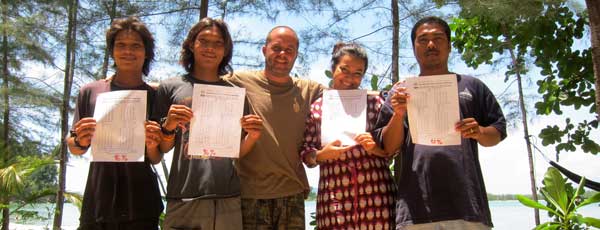
Blue Guru sponsors Thai nationals to learn scuba diving. Twins Tam & Thoom will continue their training with Blue Guru to PADI Divemaster level

- runs PADI Project Aware and Coral Reef Awareness courses for divers & non-divers to raise aquatic conservation awareness & action
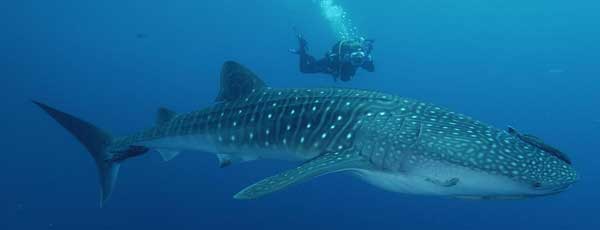
- runs the "Whale Shark Program" in conjunction with Golden Buddha Beach Resort. The PADI Whale Shark Awareness specialty course is included in this program to raise divers’ awareness and contribute to international research & conservation projects
- runs PADI Turtle Awareness specialty course to raise tourists’ awareness and participation in local conservation project run by Naucrates (see above).
- runs PADI AWARE Fish ID, Underwater Naturalist and Peak Performance Buoyancy courses to increase divers’ knowledge/skills and ensure non-damaging diving practices
- is a registered operator for Ecocean's Whale Shark Project, The Shark Trust, Coral Watch and Project AWARE
- has initiated a scuba diving training program for Thai nationals to become PADI Divemasters
- briefs all divers & snorkelers about eco-friendly practices to preserve local marine life & environments
- ensures boat crew use mooring buoys & do not drop anchors on reefs and is committed to increasing the number of mooring buoys on local reefs
- conducts CoralWatch surveys to monitor the health of local reefs & contribute to international research on bleaching effects
- organizes underwater & beach clean ups to preserve local aquatic habitats
- has developed a Coral Reef Restoration project with opportunities for staff, locals & visitors to participate
- runs rainforest trekking, mangrove boat trips & village tours using paid local guides to educate eco-tourists about local environments & cultures
- employs multi-lingual staff to aid communication & relationship development with the local community and education of eco-tourists
- creates employment & income-earning opportunities for individuals & organizations in the local community
- promotes and arranges use of transport and accommodation owned by local individuals
- is based in a natural setting at an eco-resort, Golden Buddha (see above)
- has a dive centre constructed by local craftsmen using natural materials which blends in with the palm tree lined coastline
- uses NO electricity in its dive centre and minimizes water consumption through use of dunk tanks restricted for essential kit maintenance

Note: Many of the links above refer to pages on the Blue Guru Diving website or other external websites. These external links will open in a new browser.

Click here for Contact Form

dynamite fishing is immoral
Blue Guru's Whale Shark Program contributes valuable information to help monitor this majestic ocean giant
cyanide fishing is bad too
A Coral Watch chart from the University of Queensland to check the health of local coral reefs
coral reef monitoring
The Blue Guru dive shop is based at Golden Buddha Bay. There is NO electricity here!